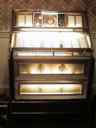
I've got a 1960's jukebox, which I've sort of restored... The original mechanism was beyond repair. It was originally put into storage because it kept breaking singles, and when I got it, it had been standing in a shed for 8 years under a plastic cover. So I've replaced the original mechanism with a more modern system. Now it must be one of the first ever Hard Drive jukeboxes.
(If anyone knows the "Limes" in Catisfield, Fareham, this was their old jukebox, the one before the blue one with the LEDs !).
How ?
Mark 1 : NICAM compression based full size jukebox
Completed around September 1997
Just over 400 audio tracks were downloaded by Digital Audio Extraction from various audio CDs, then compressed using a homewritten NICAM compressor, and dumped down onto the hard drives.
Features :-
Hardware :-
An old AMD 80386DX-40 motherboard.
A Creative Labs Vibra 16 sound card.
An 8G Quantum Bigfoot, and a 4G Quantum Stratus, giving 12G of disk space.
The front panel switches and the button release solenoid connected to the parallel port via some simple electronics.
NICAM compression was used to reduced the audio data rate from 176400 to 110690 bytes per second.
Enough disc space for over 450 tracks.
Completely homebrew software, written in C as a 16-bit DOS program.
After booting the program scans the original front panel switches, tracks are selected just like they used to with the original mechanism.
From the outside it reacts just like the original juke box would have (without the mechanical noises of course).
It runs from DOS, this means that I don't need to worry about shutting the system down properly, I can just pull the power from the wall.
Mark 2 : Mpeg 1 layer 3 compression based full size jukebox
Completed in May 1999, for a friend's wedding, it ran the entertainment for most of the evening, and was a great success !
Features :-
Hardware :-
A Pentium P166 motherboard.
A Creative Labs Vibra 16 sound card. (reused from Mark1)
An old 1.8G Western Digital drive.
Reuses the switch and solenoid interface from the Mark 1.
Mpeg 1 layer 3 compression used to reduced the audio data rate from 176400 to 16384 bytes per second,originally based on a DOS port of the mpg123 software, now based on my port of a later version, see my MPG123 for DOS page for details..
Enough disc space for over 420 tracks.
Still looks and feels like the original jukebox would.
Best next track search for improved music continuity.
LCD 16 character, 2 line display which shows what is playing and what will probably be next.
Homebrew control software, written in C as a 32-bit protected mode DOS program
(compiled with the DJGPP compiler).
All of the tracks have been catagorised, and each can be in any number of catagories (e.g. Rock, 70's, Fast, Slow etc.). When the jukebox is about to play a track it scores all of the tracks in the "toplay" list, comparing them to the track which has just finished. For each catagory which matches some points are added, if its by the same artist then more points are added, for every minute it's been waiting more points are added. Once all of the tracks have been scored, the one with highest score gets played.
Everybody asks me about the history of the jukebox, but to be honest, I don't know much about it, this is what I've been told so far :-
The company which made it was originally called AMI, the oldest manufacturer of jukeboxes in the world, it was bought out by ROWE based in grand rapids Michigan,
in the early 60's. The company still exists and now makes CD jukeboxes which are highly regarded under the name of ROWE INTERNATIONAL.
They changed the models every year, and this one is probably a Jao200 also known as a Bandstand. They made around 4700 of them in 1966.
Mark 3 : Mpeg 1 layer 3 compression based portable jukebox
The party box now has it's own page !.